
Making something complicated feel ordinary
A complete transformation of an online print service, redesigning everything from the customer journey to the production workflow behind it.
Case study overview
The challenge
Simplify online document printing for customers while reducing the manual work required by the production team behind the scenes.
The outcome
A connected service that reduced friction from upload to dispatch, gave customers greater confidence before payment and passed clearer structured information into production.
My role
End-to-end product design across the customer journey, upload and configuration flow, frontend experience, branding and production workflow.
Key areas
Product Strategy, Service Design, UX Engineering, Ecommerce
Printing online should feel as straightforward as printing at home.
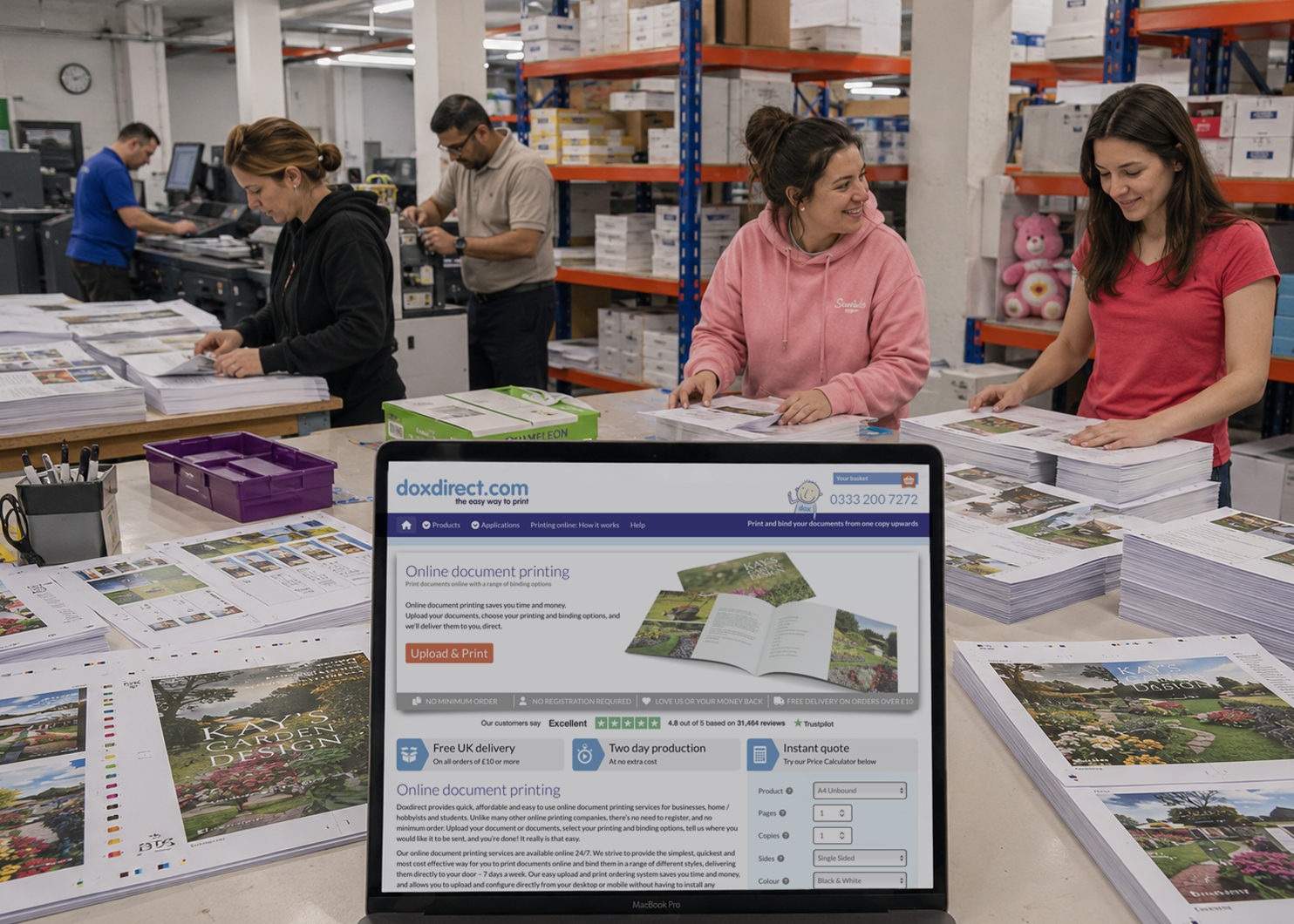
Before Page Visions acquired Doxdirect, ordering printed documents online was far more complicated than it needed to be. Customers struggled to understand print options, file previews were unreliable, pricing wasn't always clear and many orders required manual intervention before they could reach production.
At the same time the business had ambitious plans for growth. The existing platform wasn't just difficult for customers to use. It was difficult for the production team to operate efficiently. Improving one without the other would simply move the bottleneck somewhere else.
Good customer experience doesn't stop at checkout. It should continue all the way to production.02 // From website to production system
Every decision had to make life easier for both customers and the print team.
Rather than approaching the project as a website redesign, I treated it as a complete product transformation. The customer journey, frontend interface, branding and production workflow all had to work together.
The upload experience became a guided process instead of a technical one. Customers received immediate feedback about their files, clearer pricing and confidence that what they were ordering was exactly what they expected.
Behind the scenes, structured job information flowed directly into production, reducing manual checking and allowing print operators to spend their time producing work rather than fixing orders.
03 // Design decisionsReducing friction from upload to dispatch.
Simplify the upload journey
Reworked the entire upload and configuration flow so customers could complete complex print orders without needing specialist knowledge.
Build confidence before payment
Introduced clearer previews, pricing and print options so customers understood exactly what would be produced before placing an order.
Design for production as well as customers
Worked closely with backend developers to ensure structured job data flowed directly into production, reducing manual intervention and improving consistency.
Create a recognisable brand
Developed the original visual identity across the website, packaging and supporting material so the service felt trustworthy and professional from first visit to delivery.
The product evolved alongside the business.
My involvement began before the acquisition itself, supporting technical review and UX evaluation under NDA before helping shape what the platform could become. From there I led the transformation across product design, frontend development and branding while working closely with directors, developers and the production team.
Alongside delivering the product, I mentored designers moving from traditional print into frontend development, helping establish new technical skills within the team and creating a stronger connection between design and implementation.
05 // ReflectionThe best digital products improve the business behind the interface.
Looking back, Doxdirect reinforced something that has stayed with me throughout my career. The visible interface is only one part of the user experience. Real improvements often come from understanding how information flows through an organisation and designing systems that support both customers and the people delivering the service.
The platform simplified ordering, reduced support requests and streamlined production because every part of the journey was considered together rather than optimised in isolation. Much of that original thinking still underpins the platform today.